
 MX Channel System
 MX-R Roof Support
 Supports & Suspensions
 Fixings & Anchors
 Pipework Products
 Cable Containment
 Threaded Fasteners
 Screws & Rivets
 View all...
 Design, Engineering & Fabrication
 Fire Resistant Supports


 5 min read
 October 26, 2026

 Back to blog
A fire standard on a datasheet only tells you something useful if it is the right standard for the question you are asking. EN 13501-1 covers reaction to fire, EN 13501-2 covers fire resistance, EN 1363-1 sets general fire test conditions, and EAD 280016 is the method written specifically for building services supports.
They get quoted side by side, often on the same page, and they answer very different questions. This guide walks through what each one tells you about the brackets, channel and threaded rod holding up pipework, ductwork and cable containment, and what to check before you rely on a fire claim. If you want the wider picture first, start with fire resistant supports.
Why this question is landing on more projects
Supports carrying life safety systems have to stay up for as long as those systems need to keep working, so people can get out and firefighters can do their job. That has always been true. What has changed is the demand for evidence. Since the Building Safety Act, more and more M&E contractors are being asked to show that the supports will hold in a fire, not just that the services will.
The trouble is timing. Many contractors are first asked for that evidence after the supports are already installed. If the original selection was based on a generic "fire rated" claim, proving it afterwards is often impossible without ripping out and redoing work. Knowing which standard means what, before you order, is the cheapest way to avoid that.
Reaction to fire and fire resistance are different
EN 13501-1 classifies reaction to fire, which is how much a product contributes to a fire as it burns or decomposes. Classes run from A1, for products that do not add to a fire, down to E and F. MX channel, its connections and threaded rod are Class A1.
That is good to know, but it does not tell you whether a support will keep carrying its load once the fire takes hold. Steel does not burn, yet it still loses strength as it heats up. Whether a support stays up is a fire resistance question, and it needs different evidence.
What EN 13501-2 means for supports
EN 13501-2 classifies fire resistance from fire test results. For a support, the criterion that matters is R, loadbearing capacity. In plain terms, does the support keep holding its load, without losing its structural stability, for the stated time?
The numbers after the R are minutes of exposure to the standard fire curve, and that curve gets hot quickly. It passes 600°C within about 6 minutes and reaches 842°C at 30 minutes, 945°C at 60, 1006°C at 90 and 1049°C at 120. Steel loses strength sharply at around 500°C and is down to just 4% of its original strength after 90 minutes. So the gap between R30 and R120 is a very big one for a steel support.
MX channel evidence covers R30 to R120. Each result applies only to the arrangement it was tested or assessed for. Loads, spans, bracket widths and connections all change the picture, so when a specification asks for R60 or R120, check that the evidence covers the support you are actually installing.
R, E and I in a fire resistance rating
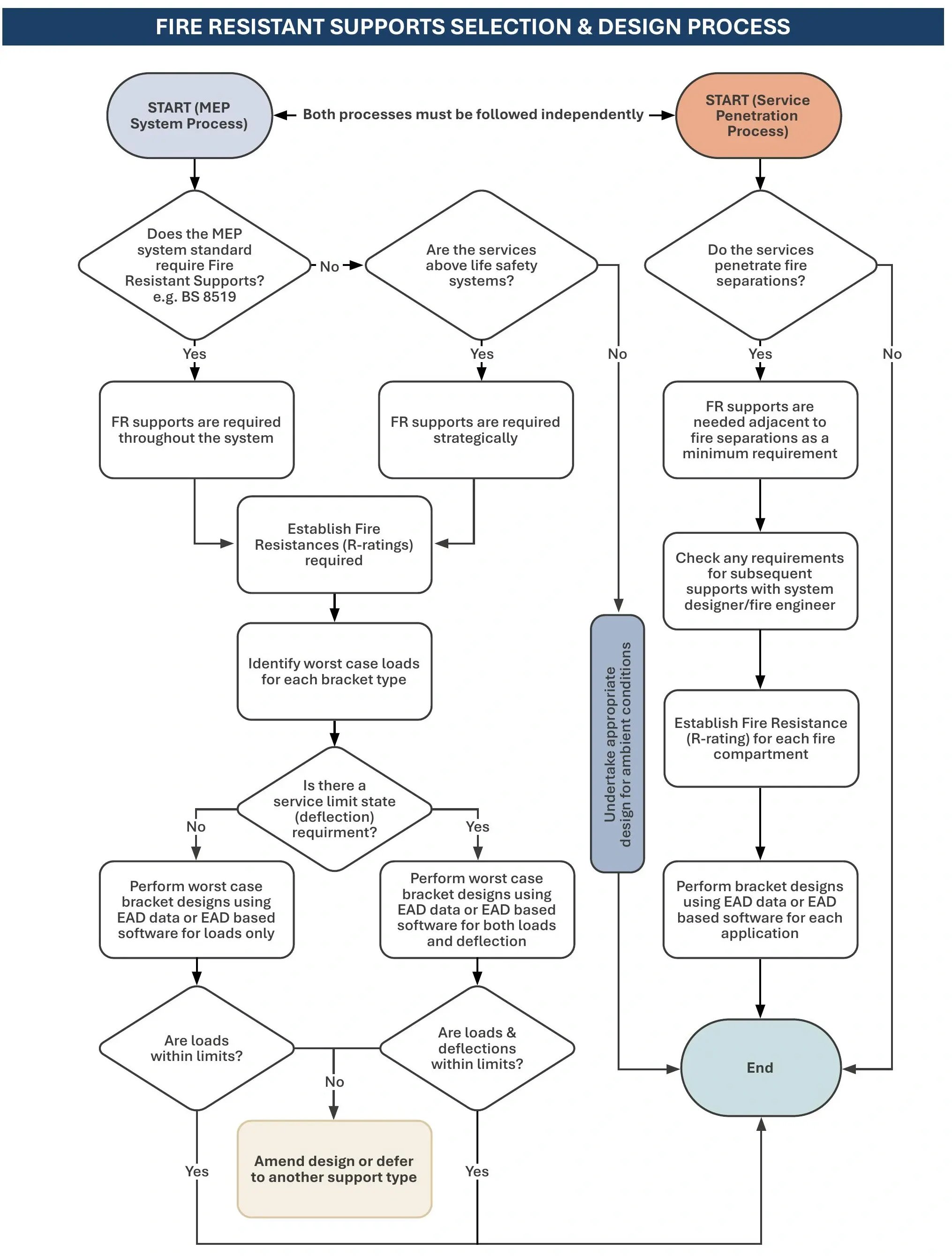
You will often see R, E and I written together, especially on walls and doors. For supports, R is the one to focus on. A support's job is to carry a load, so its loadbearing capacity is what you need evidence for. Before you carry an R rating across to a different layout, check the basis it was given on and the limits that apply.
What EN 1363-1 does and does not cover
EN 1363-1 sets the general requirements for fire resistance testing: the standard time and temperature curve, the furnace conditions, and how temperatures and measurements are taken. It applies to many kinds of building element, and it is not a test method for building services supports.
So if a document simply says a support was "tested to EN 1363-1", ask what method was used to test the support itself and which arrangement it covered. The standard number alone does not answer either question.
How fire claims for supports go wrong
The most common mistake is assuming that if a channel system has a fire test or a fire rating, any support built from it is covered. It is not. Channel systems are made up of many components that can be built into almost endless variations, and a fire test only tells you about the configuration that went in the furnace.
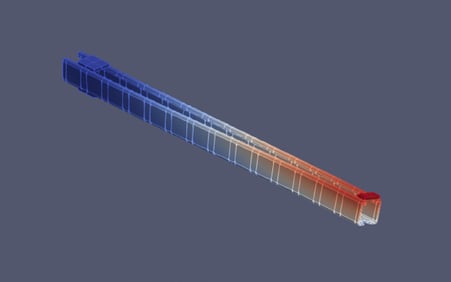
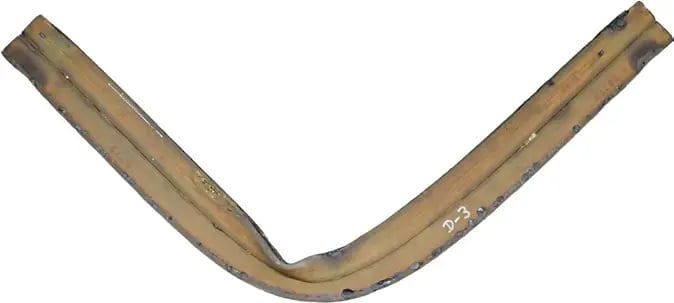
In a typical trapeze test, a bracket hangs from the furnace ceiling with weights at set positions on the bearer. As it heats, the bearer deflects into a curve and eventually buckles into a V shape, at which point it no longer carries the load. The failure can also come from the threaded rod breaking, nuts slipping or a connection letting go. Change the width, the load, the rod or the connection and you are outside what was tested.
A second trap is cable system testing to DIN 4102-12. It is a useful test of whether a complete cable system keeps working in a fire, but it covers small brackets, light loads and up to 90 minutes. It does not give you load and deflection data you can use to design supports.
For more on what a test does and does not prove, read fire tested vs fire rated. For life safety cable routes, see BS 8519 and cable supports.
EAD 280016: the test method written for supports
EAD 280016 is the European method for testing and assessing building services supports in fire, and it is increasingly recognised as the gold standard for this kind of evidence. Older approaches tested whole brackets, so the results only applied to identical brackets with equal or lower spans and loads. EAD 280016 works at component level instead, combining physical fire tests with validated modelling. That means far more support arrangements can be assessed without a furnace test for every one.
It also looks at deflection as well as collapse. That matters more than it might seem. A support that is still technically standing but has sagged badly can drop services onto a fire resistant ceiling or pull a life safety cable out of position.
MX channel supports are EAD-tested within the tested scope. Keep your arrangement inside that scope, because evidence for one arrangement does not automatically cover another.
Steel and channel in fire: the Eurocode route
Some loads and spans are simply too much for channel in a fire. For those, custom steel supports are designed by calculation to EN 1993-1-2, the fire part of Eurocode 3, with serviceability checked using EN 1990 and EN 1991 load combinations. For how steel and channel behave as they heat up, read steel in fire.
What you get from us
When we design fire resistant supports, you get two things: the physical supports, designed to meet the fire requirement, and a fire engineering report that sets out the evidence behind them. We carry design responsibility for the support arrangement, backed by professional indemnity insurance. That report is the document you hand on when someone asks how you know the supports will hold.
Five questions to ask about any fire standard reference
- Is it about reaction to fire or fire resistance?
- Does the evidence show loadbearing capacity for the stated time?
- Is the standard a general test condition or a support-specific method?
- Which support arrangement does the evidence cover?
- Does your arrangement sit within that scope, or does it need its own design assessment?
A standard number is a starting point. What counts is the evidence behind it and whether it matches what is going in on site.
Frequently asked questions
What is the difference between EN 13501-1 and EN 13501-2?
EN 13501-1 classifies reaction to fire. EN 13501-2 classifies fire resistance from fire test results. For a support carrying a load, the fire resistance criterion that matters is R.
Does an A1 classification mean a support will carry its load in a fire?
No. A1 describes reaction to fire. Steel does not burn, but it still loses strength as it heats up. Whether a support keeps carrying its load needs fire resistance evidence for that specific arrangement.
Is EN 1363-1 a fire test method for supports?
No. EN 1363-1 sets general requirements and conditions for fire resistance testing. It is not a test method for building services supports.
What does R mean in R30 or R120?
R is loadbearing capacity, and the number is the time in minutes on the standard fire curve. An R rating applies only to the arrangement it was established for, so it is not a blanket rating for channel or brackets.
What is EAD 280016 used for?
EAD 280016 is the method for testing and assessing building services supports in fire, covering both collapse and deflection. MX channel supports are EAD-tested within the tested scope.
What should I check before applying a fire performance result?
Check which support arrangement the evidence covers, including components, loads, spans and connections. Then confirm that your arrangement falls within that scope, or get a separate design assessment.
Request the FRS Technical Guide
Working through a fire requirement on a live project? Request the FRS Technical Guide for the full technical detail, or talk to us about your support arrangement.
Request the FRS Technical Guide, or visit our page on fire resistant supports.